
ELECTRONIC MICROSCOPY PRODUCTS
Desktop/compact TT/SEM microscopes
Making SEM accessible for anyone, everywhere
Table-top SEMs have great advantages and on the one hand we can understand them as the gateway to electron microscopy, as they can complement the controls performed by optical microscopy, providing the necessary resolution and magnification while providing compositional information on the samples.
On the other hand, they allow to complement the use of research electron microscopes, easing the workload or allowing a department or work group to have its own SEM and reducing the need to subcontract measurements for more advanced tests.

If what you are looking for is an economical microscope that is quick and easy to operate and at the same time so intuitive that it can be handled by non-specialized personnel after a few minutes of training, we can help you.
The fast tabletop SEM to image, measure, and analyze the composition of samples from your own lab. Its small size combined with its great robustness make this equipment an excellent ally for both research and industrial laboratories, as it does not require any adaptation of the facilities.
If you want to use your SEM for more than just getting beautiful images with a large depth of field, you can’t ignore the most important part of electron microscopy, the electron beam hitting the sample and the secondary and backscattered electrons leaving the sample. and.
If we want to take advantage of one of the best features that an SEM can provide us, bone microanalysis, the ability to identify elements or contaminants in our sample, we cannot ignore the behavior of the electron beam that hits the sample.

What we are often not told when talking about desktop SEMs is that the design of the equipment greatly limits the performance of the equipment. On the one hand we will sacrifice performance in electronic optics by limiting the acceleration voltages at which we can work and the resolution of the detectors. An accelerating voltage of less than 15 kV will greatly limit the elements that we can adequately excite and therefore detect by EDS.
Wood, Textile and Paper


This composition information will be essential for us to study possible contaminants in the control of manufacturing processes, quality control or materials research, providing us with important information.
Cost of ownership – equipment requirements – maintenance
Benchtop SEMs don’t require specialized infrastructure or expert supervision, so we can place them in virtually any laboratory. They do not require maintenance contracts, which makes them very attractive.
However, the size of their electron column and the design of their detectors mean that they cannot be repaired on site and must be sent to the factory for repair, with consequent disruption and economic costs.
Fortunately, state-of-the-art tabletop microscopes allow the user to change the electron source themselves (after brief training during installation) and the equipment can be upgraded and repaired on site by technical service.
If this were not limiting enough, if we do not have a sufficiently clean vacuum level (high vacuum) and we necessarily have to work in low vacuum (or high pressure) mode, our electron beam will be continually disturbed by the air molecules that remain in the microscope. The last thing a microscope manufacturer wants is to have to work all the time, especially with samples that don’t need it, using a very low vacuum level.

Aware of all these limitations, TESCAN designed its own solution for customers looking for an intuitive, easy-to-use and affordable microscope, the TESCAN VEGA 4 Compact.Now the only real reason to buy a benchtop SEM will be if you have an extreme space limitation in your laboratory, if this is the case, ask for a benchtop SEM with high and low vacuum and that is not limited to reaching an acceleration of 30 KeV.
For all other situations, you no longer need to give up ANYTHING to have your own SEM, access our VEGA Compact. It will not disappoint you.
TESCAN desktop/compact solutions
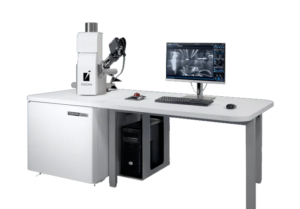
TESCAN VEGA 4 COMPACT
Analytical SEM for routine materials characterization, research, and micrometer-scale quality control applications.

NANOS
High-quality SEM images with low cost of ownership and integrated energy dispersive spectroscopy (EDS) for fast elemental analysis.